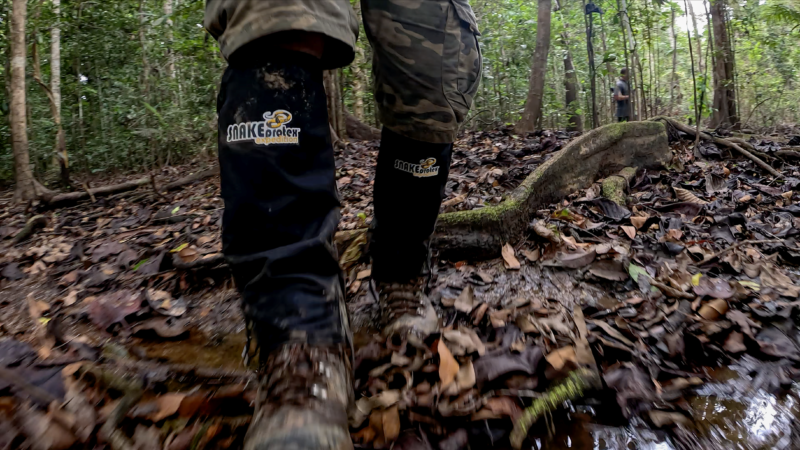
By Dave Abbott – filmmaker, ecologist and world traveller.
In 2025 Dave reached out to the team at SPX with a simple request – could he bring along a pair of SnakeProtex on his trip to Papua New Guinea? Our answer was of course, YES! You see we love putting our product to the test – and what better place to do that in the remote reaches of Papua New Guinea, a landscape postively teeming with snakes. This is David’s first-hand account of the trip and how SnakeProtex performed for him in the wild….
In a country where 4 people a day die from snakebites, it’s an eerie feeling crunching through the deep leaf litter of a tropical forest knowing that your next step might disturb a snake venomous enough to kill you within a few hours. When you also know you’re a day or two away from any medical help, it raises the stakes even more!
Let me backtrack and put this into context; – not long ago I did one of the wildest filming trips of my life to a remote part of Western Papua New Guinea (PNG), to film a clan of hunter-gatherers in an isolated village only accessible by river, in the middle of a vast tropical forest.
The people of this village still live off the land as their ancestors have for generations, – hunting and fishing through the endless, untracked forests and river systems for wild pigs, deer, cassowaries, and crocodiles.
As well as an incredible diversity of birds, bats, mammals and reptiles, this largely untouched area of forest, swamps and freshwater lagoons is home to half a dozen highly venomous and potentially lethal snakes, – species that are responsible for at least a thousand deaths a year across PNG…which translates to around 4 deaths every day.
The most venomous snake in PNG -and top of the list of snakes I didn’t want to meet on this trip was the Papuan Taipan, a large, aggressive and fast moving snake that is active during the day, and if disturbed, bites multiple times in quick succession, injecting large amounts of a potent, neurotoxic venom.

The Death adder was another species I was keen to avoid – smaller than the Taipan but still highly venomous, this species is apparently responsible for a lot of the snake bites in PNG because of their habit of hiding in long grass and leaf litter close to pathways during the day. Like the Taipan their venom contains neurotoxins that can cause paralysis and death.
Two other snakes that I didn’t particularly want to come across were the Papuan Black snake and the New Guinea Brown snake, both potentially lethal species with powerful neurotoxic venom that can cause haemorrhagic bleeding and other problems…like death for example..

It’s serious enough getting bitten by a venomous snake in Australia or the US, where you are most likely going to be able to get emergency treatment and anti-venom reasonably quickly, but in the part of PNG we were going to be working, it was a 7hr, 150km river trip to the nearest clinic, which was at best extremely basic (and may or may not have antivenom anyway), and many more hours if not days to get to a proper hospital.
Because of this, and the remoteness of the area, we looked into the idea of getting hold of some antivenom to take with us, -until we found out that antivenom has to be refridgerated – which would be impossible where we were going. We also learnt that it has to be administered intravenously with adrenalin on hand in case of adverse reaction, which required a bit more medical skill than any of us had.
Seeing as the chances of getting treatment for a snake bite was going to be sketchy at best, I started looking at how to avoid getting bitten in the first place.
It turns out that most snake bites are to the feet, ankles and lower legs, which makes sense given that most snakes live and hunt on the ground, so the most effective protection against a bite if you’re in snake country is to wear decent leather boots and a good pair of snake gaiters.
I already had boots, but the gaiters I use in the bush in New Zealand are only light canvas, which probably wouldn’t give me much protection against a snake bite given that a snake’s fangs are like ultra sharp hypodermic needles, and that Taipan fangs are a good half an inch long.
A bit more research confirmed that to be considered ‘snake proof’, gaiters need to made of a lot heavier material than your average hunting gaiters, so after a bit of searching online I eventually found a brand that professional snake-catchers use in Australia, called Snake Protex Expedition gaiters, and got in touch with the distributors – Woodchuck Landscaping. ,They not only gave me some useful advice, but also very kindly sent me a pair of gaiters to use on the expedition!
Luckily they arrived just before I left for PNG which made me feel way more comfortable about the trip, as I knew we were not only going to be walking through the forest during the day, but also at night, in places where there would be thick leaf litter, long grass, rotten logs, and all the places snakes love to hang out, – so the standard advice to ‘avoid their habitat’ wasn’t going to be an option on this trip!
I soon got used to putting the gaiters on anytime we were going into the forest, and they were comfortable enough to walk in all day, as well as giving welcome protection against cutty grass and mozzies, as well as snakes!

As it happened, the only snakes we came across the whole time we were there were a couple of pythons, but we were told by one of our hunters that a young girl in the village we were staying at had sadly died from a snake bite only a few weeks beforehand, so it’s definitely a very real risk in this part of the world.

Given that around 80% of snakebites occur below the knee, simply wearing a good pair of snake gaiters can cut your chances of getting bitten down considerably, so If you’re planning on traveling anywhere that has a lot of venomous snakes – like India, Africa, Papua New Guinea or Australia for example, you should definitely pick up a pair, – they could literally save your life.
Here’s a last quick statistic to put that in perspective: – around the world about 175,00 people a year die from snakebites, – in India alone there are roughly 50,000 people killed by snakes every year, – that’s about 130 people every day and most of those deaths could be prevented by wearing boots and gaiters.
[All photos kindly credited to David Abbott @ Liquid Action Films]